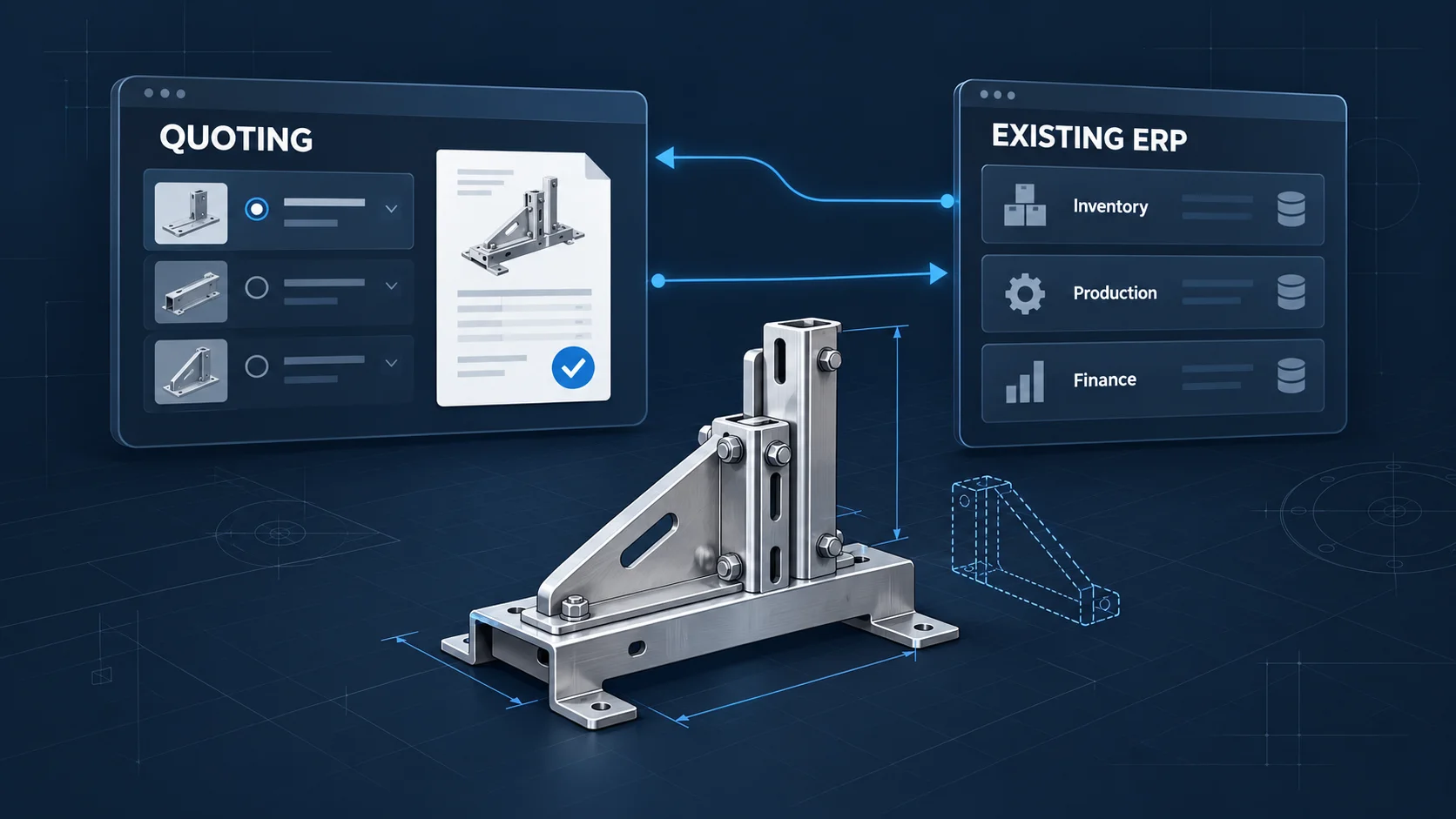
Test what your existing module already does, map who owns pricing and BOMs, and know the integration questions to ask before you buy anything.
LF
Lamar Falconer
Founder & CEO, AltoLeap
November 1, 2026
7 min read
Yes, and the two decisions should stay separate. Improving how a configuration gets built, priced and approved does not require moving inventory, purchasing, production release, shipping or financial posting out of the system that already runs them. Replacing an ERP is a large decision with its own business case, and a quoting project that quietly becomes one has gone wrong.
There is a second answer worth having before you shop for anything. Your ERP may already do more of this than you think. We build configurators and quoting systems that connect to an existing ERP, and the honest first step is still to find out what the system you already own can do.
A note on how to read what follows. Every technical claim here is attributed to a specific product’s documentation, because capabilities differ enormously between them and generalising across ERPs is how people end up buying software they did not need. Where no defensible number exists for a claim, we say so rather than borrowing one.
What stays in your ERP when you fix quoting?
Its operational authority. That is the part worth protecting, and it is different from simply keeping the licence while rebuilding the business logic somewhere else.
A workable division of responsibility looks like this. It is a design agreement, not a rule that applies to every manufacturer.
Record
Who should own it
What moves
Item master, part numbering
ERP, for released operational items
Identifiers flow out to quoting. New configured items come back through one controlled creation process. Never let two systems assign part numbers independently
Cost inputs
The designated cost source, with ERP actuals where already held
Costs flow to the estimate carrying their date, currency and basis
Price lists and contract prices
A named commercial owner, implemented in one place
Either the ERP calculates the selling price, or approved reference prices are published into the quoting layer
Inventory and availability
ERP
A read-only lookup. Seeing a quantity is not a reservation and not a delivery promise
Product rules
One authoritative engine
Other interfaces consume its output rather than keeping a second editable copy
Configured BOM and routing
Authoring and release are different jobs
The configurator can propose a structure. The ERP holds the released one that production and accounting use
Sales orders, production, invoicing
ERP
Accepted quote goes in, order identifier and status come back
The useful question is not “CPQ or ERP?” It is narrower, and it has three parts:
Which system authors the product rules?
Which governs the selling price?
What has to happen before an accepted configuration becomes something the floor can build?
Those three answers determine the architecture. The software category does not.
Can your ERP’s existing module already do this?
Possibly, and capabilities differ sharply by product, which is why this question has to be answered about your ERP rather than about ERPs. The broad claim that ERP configurators only handle simple option picking is contradicted by the vendors’ own documentation.
Microsoft documents, for Dynamics 365 Supply Chain Management specifically, constraint-based product configuration models with calculations, BOM lines and route operations, and configuration directly from a sales quotation line. That is a real engineering configurator, not a dropdown. Business Central is a different product and documents something different: customising assembly lines during an assemble-to-order quotation, with the customisation carried to the accepted sales order. Both are Dynamics. They are not interchangeable, and a vendor who says “Dynamics can do it” without naming which one has not answered the question.
The same pattern holds elsewhere. Infor documents LN running its Product Configuration module without CPQ integration at all, generating item structures and routings itself. Sage documents X3 configuration scenarios launched from quote entry that create products, components and operations. Odoo’s version 19 documentation covers variant-specific BOM components and operations. Epicor describes a configurator built into Kinetic, separate from the Epicor CPQ product it also sells. NetSuite is the useful counterexample: its CPQ Configurator and CPQ Manufacturing are SuiteApps with installation and feature prerequisites, so an existing NetSuite subscription does not automatically include them.
So the first thing to do is a demonstration, not a shortlist
Take a real quotation your team has already produced, de-identify it, and ask your ERP partner to reproduce it in the installed, licensed module in front of you. Insist on seeing:
The demonstration checklist
A straightforward configuration, and a difficult but valid one
An invalid combination that must be blocked
A configuration that changes components, and one that changes operations or processing time
A customer-specific price and a quantity break
A requirement outside the model, routed to engineering
A revised quote that keeps its accepted history
The winning quote converted into an order and a manufacturing structure
A handoff that fails partway, and the recovery
Agree what “passing” means before the demonstration rather than after. If the native module passes, your project is data, setup and training, which is a much smaller thing than buying another system. Our guide to CPQ for manufacturers covers where the category genuinely earns its place.
A separate layer is justified when a demonstrated gap has a real consequence: a rule the native model cannot express without unsustainable effort, a selling workflow your dealers or reps cannot actually complete, exceptions and revisions that cannot be governed, or an accepted configuration that gets rebuilt by hand for production every time. A gap also does not automatically mean a full replacement. A better interface over the rule engine you already own is a legitimate third answer, and it is worth putting on the table alongside the other two.
What data actually moves between quoting and the ERP?
Less than most integration diagrams suggest, and the direction matters more than the volume.
Item identities flow out of the ERP. Cost inputs flow out too, and they need to arrive carrying their date, currency, unit and basis, because an estimate built on last year’s standard cost is wrong in a way nobody notices.
Estimated cost is an input to a pricing decision, not the quoted price. Commercial policy and judgment sit in between, and collapsing them is how margin quietly disappears.
Availability is the one people get wrong. A stock lookup is information, not a commitment. Microsoft states plainly that Business Central assembly-quote quantities do not enter availability, planning or reservations. Whether your ERP reserves anything at quote time is a question to ask explicitly, before a number on a screen becomes a date you promised a customer.
CAD/USD. For Canadian manufacturers quoting in both CAD and USD, put the currency and the approved exchange-rate date into the acceptance test alongside everything else. It is a small thing that causes arguments later.
How does an accepted quote become a production-ready order?
Through three separate milestones that are easy to draw as one arrow and expensive to treat as one.
Milestone
Record
What it is
1
Accepted quote
A commercial agreement
2
ERP sales order
An operational record
3
Released structure
What the floor builds from
Different systems reach these in different ways. Business Central exposes a sales quote resource with a makeOrder action. NetSuite’s REST interface can transform an existing estimate into a sales order, while its CPQ Manufacturing SuiteApp separately uses configured materials and routing steps to create work orders. Those are not the same capability, and an order-creation endpoint does not establish that configured BOMs and routings will follow through the same path.
Design for the failures, because they are specific and predictable:
The ERP commits the order and the caller times out.
A line is rejected. A material is missing.
Engineering revises the configuration after acceptance, which Oracle documents can leave an existing NetSuite work order outdated.
A retry must first establish whether an order already exists rather than blindly creating a second one. Someone has to own that recovery by name.
The practical safeguard is to carry a stable quote identifier and accepted revision through every step, and to treat a successful HTTP response as a delivery receipt rather than proof the business transaction completed.
What can go wrong, during the project and after it?
Four things, and all four are manageable if you name them early.
The project grows into something else
This is a scope risk rather than a technical inevitability. Contract the Phase 1 boundary explicitly, and treat any discovered need to replace planning or accounting as a separate decision that gets its own approval.
Two systems author the same rule
That is a genuine cost, paid forever. Pick one authoritative engine per rule domain and make sure the other interfaces consume a generated copy rather than an editable second original.
The ERP and the quoting layer disagree about price
Decide which price is committed, when repricing is allowed, what triggers reapproval, and how rounding and currency reconcile. Test what order entry does with an approved quote price.
An upgrade changes something underneath you
This one is concrete rather than theoretical. Microsoft documents the removal of Business Central API v1.0 in the 2026 release wave 1 with migration to v2.0, and separately documents SOAP deprecation. Oracle publishes a NetSuite Release Preview test plan covering customisations and installed SuiteApps, and an October 2026 NetSuite CPQ release note describes changed template-assembly BOM behaviour under stated conditions. None of that means upgrades always break integrations. It means regression testing is part of the operating cost, not an optional extra, and nobody should sell you a maintenance-free connector. If you want that work planned properly, it is what systems integration is for.
What should you ask your ERP partner before deciding?
Six questions, in this order:
Which of our requirements does the installed, licensed version already meet? Show us using our quotation.
Which need configuration, an extension, another licence, or custom development, and what does each add to upgrade work?
Can we create or identify the configured item, BOM and routing through supported interfaces, and which approvals are required?
Where is the authoritative price calculated, and will order entry honour the approved quote price or recalculate it?
What happens when the order is committed but the caller times out, and how is a duplicate prevented?
Can you quote the native-module option and the minimum integration scope separately, with recurring charges and exclusions?
Ask for the native-module option to be priced. A partner who will not quote the cheaper answer is telling you something.
Where to start
Work out what this would leave unchanged in your shop. Bring one product family, a recent quote, the order it became, and your ERP’s product and version. Those four things are usually enough to locate the boundary.
AltoLeap is a Toronto-based custom software company that has been building configurators and quoting systems for made-to-order, configure-to-order and engineer-to-order manufacturers since 2012. A free 20-minute Fit Call is the easiest place to start, and the most useful outcome is sometimes finding that your existing module can do the job. If the answer is an integration, read how we approach systems integration.
A note on sources. The product behaviour described here comes from documentation published by Microsoft, Oracle, Infor, Sage and Odoo, plus Epicor’s own product capability pages, which are vendor material rather than technical documentation. It establishes how those specific products work rather than how every ERP works. We looked for a defensible benchmark on integration cost, duration, error reduction or return for this kind of project and could not find one, so this article describes mechanisms and tests instead of borrowing numbers. Widely repeated CPQ performance figures traced back to vendor marketing without a usable method, and we left them out.
Ready to see where this fits your operation?
What would this leave unchanged in your shop?
A short conversation is the fastest way to know whether CPQ is worth it for you. Book a Fit Call and we'll walk through your quoting process, or start with an AI Opportunity Blueprint to find the highest-value automation before you build anything.
What to settle before connecting quoting to your ERP
Does CPQ replace an ERP?
No. Adding a configuration or quoting layer does not require replacing the ERP, which keeps inventory, purchasing, production release, shipping and financial posting. What changes is where product rules are authored and where a configuration is built, priced and approved before an order exists. The exact boundary depends on which products you are joining and how they are configured.
Can our ERP’s own module already do this?
Possibly, and it is worth checking before buying anything. Microsoft documents constraint-based configuration with calculations, BOM lines and route operations in Dynamics 365 Supply Chain Management, Infor documents LN generating item structures and routings without CPQ integration, and Sage documents X3 configuration scenarios launched from quote entry. Capabilities differ sharply by product and version, so ask your partner to demonstrate your own requirements in the installed, licensed module.
What data has to move between quoting and the ERP?
Item identities, cost inputs with their date and basis, the applicable prices, availability information, the accepted configuration, and the resulting order. Some products also generate or receive manufacturing structures. Confirm specifically whether your handoff creates BOMs, routings or work orders, because an order-creation endpoint does not establish that the manufacturing structure follows the same path.
Who should own pricing after integration?
Whoever you decide, implemented in exactly one place. It is not automatically the quoting layer: ERP price lists can stay authoritative while an approved configuration price is applied elsewhere. Keep estimated cost separate from the committed selling price, and test what order entry does when it receives an approved quote price.
Does a quote reserve inventory or guarantee a delivery date?
Do not assume so. Microsoft states that Business Central assembly-quote quantities do not enter availability, planning or reservations, so a quantity shown during quoting may commit nothing at all. Confirm the reservation and scheduling behaviour of your own ERP before turning a stock lookup into a date you promise a customer.
What can break when the ERP is upgraded?
Interfaces and behaviour can change. Microsoft documents the removal of Business Central API v1.0 in the 2026 release wave 1 and the deprecation of SOAP web services, and Oracle publishes release-testing guidance covering NetSuite customisations and installed SuiteApps. Budget regression testing of quote conversion, pricing and structure creation as part of running the integration, not as an exception.
How long does ERP integration take?
No defensible general answer exists, and anyone offering a fixed number of weeks before seeing your systems is guessing. A scoped estimate needs the actual object mappings, the native-module fit, your data quality, the manufacturing outputs required, and the test coverage, with your ERP partner’s work costed separately from the integration work.